Introducing:
Spotify Duet

Introducing:
Spotify Duet

Introducing:
Spotify Duet

Spotify's mission is to be the world's #1 audio streaming platform. My proposal, Spotify Duet, introduces an in-app music-sharing feature designed to strengthen social connections and drive retention making Spotify a platform for sharing music, not just consuming it.


Edit (October 2025): Spotify has since introduced a messaging feature. I'm not saying they were inspired by my LinkedIn post about this project. I'm not saying that at all…

The Problem

Spotify dominates the music streaming market but lacks a native social feature that keeps users within the app ecosystem.


Users rely on external messaging platforms to share music, which interrupts the listening experience and fragments Spotify's engagement loop.

My Solution

What if Spotify could make music sharing more personal and seamless, without compromising its core identity as a listening platform?


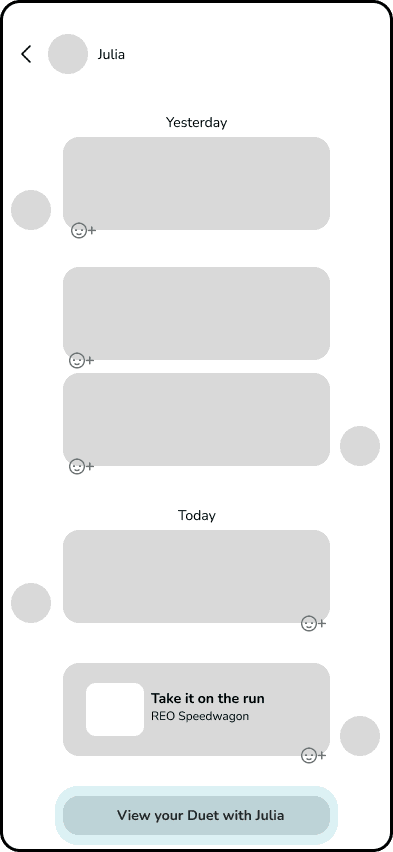
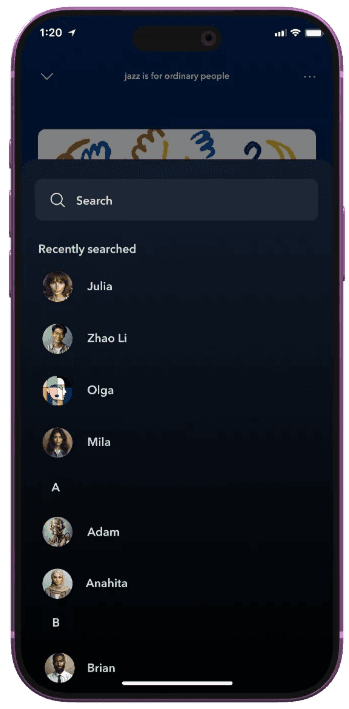
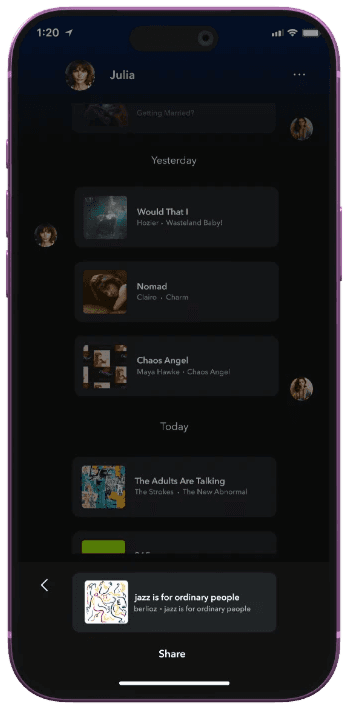
Enter Spotify Duet: a built-in feature that allows users to send songs directly to friends. Each shared conversation automatically creates a Duet Playlist, compiling all the tracks exchanged within that inbox.

The Psychology Behind It

From a psychological standpoint, music sharing is a form of social bonding. Recommending a song is an act of self-disclosure, you're sharing something about your taste, your mood, and ultimately your identity.


Forcing that interaction through a third-party app adds friction to what should be an instinctive, in-the-moment behaviour. The goal of Duet was to remove that friction and let the behaviour happen where it already starts: inside Spotify.

The Process: Research and Exploration

The Problem

To validate this idea, I conducted a survey of 14 participants aged 15–25, Spotify’s primary demographic.


The goal was to explore user attitudes toward an in-app sharing feature before investing in design, and to surface constraints early.

Spotify dominates the music streaming market but lacks a distinct feature that encourages users to stay within the app.


Users often rely on external messaging apps to share music whiich interrupts the listening experience and dilutes Spotify’s ecosystem.

The Solution

What if Spotify could make music sharing more personal and seamless, without becoming yet another messaging app?


Enter Spotify Duet: a built-in feature that allows users to send songs directly to friends. Each shared conversation automatically creates a Duet Playlist, compiling all the tracks exchanged within that inbox.

The Psychology Behind It

From a psychological standpoint, music sharing is a form of social bonding. Recommending a song is an act of self-disclosure, you're sharing something about your taste, your mood, and ultimately your identity.


Forcing that interaction through a third-party app adds friction to what should be an instinctive, in-the-moment behaviour. The goal of Duet was to remove that friction and let the behaviour happen where it already starts: inside Spotify.

The Process: Research and Exploration

User Interviews

To validate this idea, I conducted a survey of 14 participants aged 15–25, Spotify’s primary demographic.


The goal was to explore user attitudes toward an in-app “chat” feature focused on sharing music.

Why a survey? Because it would allow me to quickly gauge attitudes across a broad slice of Spotify's core demographic without introducing interviewer bias at this early stage.

70%

want to keep track of music they have shared and received

"It’s a lot more convenient to receive and play a recommendation in the app compared to receiving a link on another app and getting redirected."

"It’s a lot more convenient to receive and play a recommendation in the app compared to receiving a link on another app and getting redirected."

85%

would use a feature that allowed them to share music directly within the Spotify app

"Sharing music directly through the app could be useful"

"Sharing music directly through the app could be useful"

50%

want this feature to only allow music-sharing, not music and regular messages

"If it was just recommending music then yes [I would like an inbox feature], but if it became just another app to message on, then no."

"If it was just recommending music then yes [I would like an inbox feature], but if it became just another app to message on, then no."

Key considerations at this stage

Interestingly, Spotify once had a full-fledged messaging feature — but it was discontinued due to low engagement and high maintenance costs. This insight informed three guiding principles for my redesign:

Interestingly, Spotify once had a full-fledged messaging feature — but it was discontinued due to low engagement and high maintenance costs. This insight informed three guiding principles for my redesign:

✽ Music sharing must be the core purpose of the feature

✽ Music sharing must be the core purpose of the feature

✽ The design of the feature must reinforce its purpose

✽ The design of the feature must reinforce its purpose

✽ Ease of use is essential to encourage discovery and adoption

✽ Ease of use is essential to encourage discovery and adoption

The Process: Wireframing and Prototyping

Low-fidelity wireframes

Proposed flow:

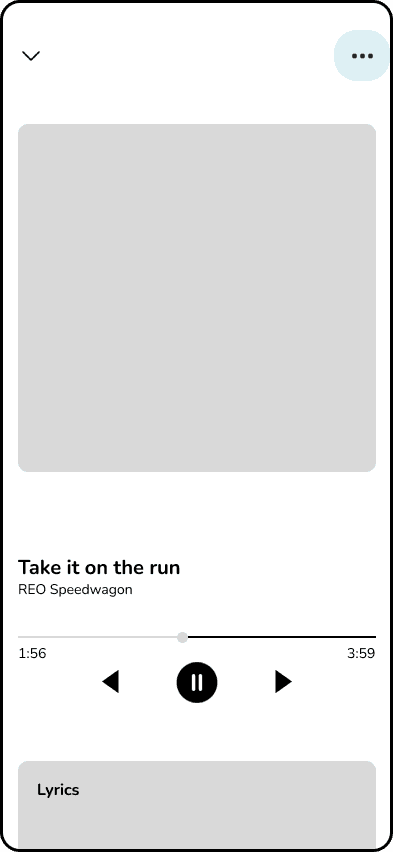
Step 1. Tap the three-dot menu on a song.
Step 2. Select “Share via Duet.”

Step 3. Choose a recipient and hit send.
Step 4. Access your Duet Inbox, which automatically creates a shared Duet Playlist of exchanged songs.


This design ensures that users don’t have to learn anything new. It feels intuitive and native to Spotify’s existing interface.
How does the above solution address the aforementioned considerations?

✽ Music sharing must be the core purpose of the feature

Only music can be shared using Duet; text messages cannot.

✽ The design of the feature has to reinforce its intent

Users are never presented with a text input or chat box. The interface is intentionally limited to music sharing.

✽ Ease of use is essential to encourage discovery and adoption

Positioning 'Share via Duet' next to the existing 'Share' option lowers friction for first-time users.

The Process: Wireframing and Prototyping

High-fidelity wireframes

The Process: Wireframing and Prototyping

High-fidelity prototype

This project deepened my understanding of how user research should drive product decisions, not validate them. I initially assumed users would welcome a full messaging feature, but the data revealed a clear preference for music-only interaction. Adapting to that insight rather than defending my original assumption led to a more focused, usable solution.


Interestingly, the chat feature that Spotify has since introduced does allow for regular text messages to be sent as well as music. I haven't seen much online regarding this feature, but if this Reddit post is considered valuable insight, perhaps I was onto something…


Check out the full prototype here.

nivedita venkatesh

nivedita venkatesh

nivedita venkatesh